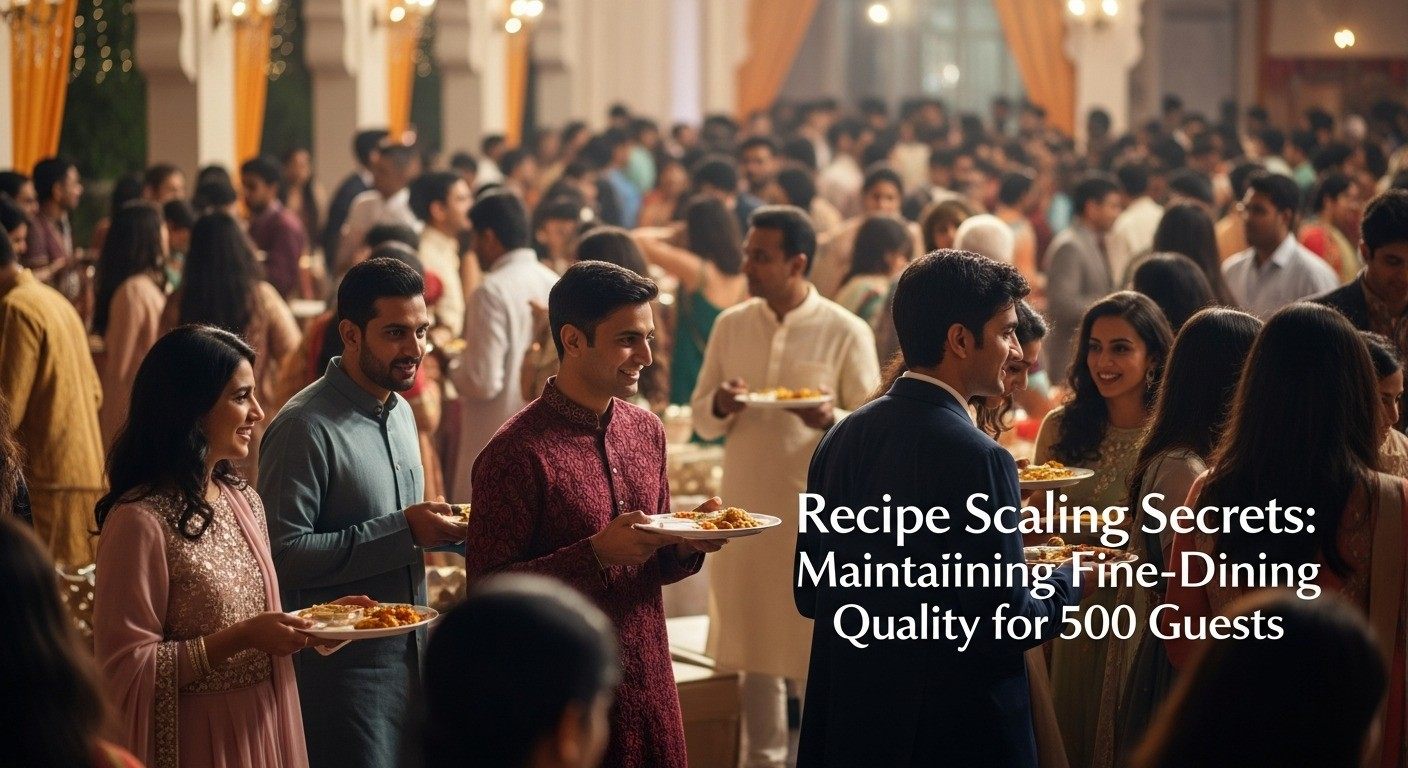
Recipe Scaling Secrets: Maintaining Fine-Dining Quality for 500 Guests
The biggest misconception about scaling recipes is that it is a simple arithmetic problem. Double the guests. Double the ingredients. That logic fails the moment you actually step into a commercial kitchen. The reason is surprisingly simple. A small pan loses heat quickly. A large industrial pot holds heat for much longer. That means something that simmered gently for fifteen minutes in a small pan might actually overcook in twelve minutes in a large pot because the residual heat keeps cooking it even after the flame happens to be turned off.
At Sanskar Caterers, the team spends weeks testing scaled versions of every dish before they ever serve it to a paying guest. At every stage, they adjust. Less salt because the longer cooking time concentrates flavors. More liquid because larger pots evaporate faster. Different stirring techniques because the bottom of a large pot burns more easily. These are not things you learn from a cookbook. These are things you learn in the kitchen.
This is what makes catering services in Raipur stand out when they are done right. The willingness to fail in practice so you never fail at an event. The best teams have burnt more dal than they would ever admit. They have thrown away entire batches of gravy because the spice balance was off. They have stayed up until 2 AM reworking a recipe that just would not behave at scale. And that is exactly why on the day of your wedding, the food tastes like it was made with love. Because it was. And also because someone already made all the mistakes when you were not watching.
The Role of Technique Over Quantity
Here is another secret that most home cooks never realize. When you scale a recipe, you are not just scaling ingredients. You are scaling techniques. A small pan of sautéed onions takes about eight minutes. A massive pot of onions might take forty minutes because the heat takes longer to penetrate. But if you cook onions for forty minutes the same way you cooked them for eight, they will burn on the bottom before the top is even translucent. So you change the technique. You stir more often. You lower the heat. You add a splash of water, etc.
The same principle applies to almost everything. Sanskar Caterers has built their reputation on mastering these techniques. When people search for top caterers from Raipur, they are not just looking for someone who can cook. They are looking for someone who can cook at scale without losing the soul of the food. That takes years of practice.
Standardizing Without Losing the Human Touch
One of the hardest lessons in large-scale cooking is that you cannot rely on a single person's instincts. If one chef tastes the gravy and adds salt, and another chef tastes the same gravy and does not, you have inconsistency. So, you develop systems. You write down exact measurements. You train every single person on the line to taste the same way. You use measuring tools even when you think you do not need them.
But here is the delicate balance. Standardization should never mean lifelessness. The best catering services near me are the ones that have clear systems but also leave room for human judgement. A recipe might call for three tablespoons of garam masala. But if the batch of garam masala that arrived this morning is more potent than the last batch, the chef needs the freedom to adjust. That is not a deviation. That is expertise.
At Sanskar Caterers, the team uses what they call guided flexibility. Every cook knows the baseline recipe. Every cook also knows the five most common adjustments that might be needed. Too much heat in the tomatoes. Too little body in the gravy. Over-roasted spices. Every cook is trained to identify these issues and correct them beforehand. That is how you serve five hundred plates that all taste the same.
The Equipment Factor that Nobody Talks About
You cannot scale a recipe if you do not have the right equipment. A home stove cannot handle a hundred-liter pot. The heat is uneven. The flame is too small. The pot itself might not even fit. Commercial kitchens solve this with specialized equipment.
But having the equipment is not enough. You have to know how to use it. Every piece of equipment changes the way a recipe behaves. The team at Sanskar Caterers tests every recipe on every piece of equipment they might use.
When clients look for the best caterers from Central India, they rarely think about equipment. They think about taste and presentation. But behind every perfectly scaled dish is a piece of equipment that was chosen specifically for that task.
The Tasting Protocol at Scale
Here is a final secret that most caterers will not share. Even after all the testing and all the systems, the team tastes constantly during the actual event. Not at the beginning. Not at the end. Throughout. The head chef tastes every batch of gravy before it leaves the kitchen. The team leader tastes the first ten plates that go out to ensure consistency.
At Sanskar Caterers, there is a rule. If you would not serve it to your own mother, don't send it out. That sounds simple. But when you are serving five hundred guests and the pressure is high, it is easy to let things slide. One batch of dal that is slightly saltier than the last. One tray of vegetables that spent two extra minutes under the heat lamp. These small slippages add up. The teams that win are the teams that refuse to accept them. They taste constantly. They adjust constantly.
Why This Matters to You
The next time you are planning a large event and searching for catering services in Raipur, ask the tough questions. How do you scale your recipes? How do you train your team to maintain consistency? How do you handle the difference between cooking for ten and cooking for five hundred? The answers will tell you whether you are hiring someone who understands the craft or someone who is just hoping for the best.
At Sanskar Caterers, they have spent years learning these lessons. They have burnt the dal. They have thrown away the gravy. They have stayed up late testing and retesting. And that is exactly why when they serve your event, you will not be able to tell the difference between the first plate and the five hundredth. Because for them, every plate is the only plate that matters.
Recent Posts
Why Catering Is Not Just About Food

Behind the Scenes: A Day in the Life of a Premium…
Best Ways to Source Local Ingredients in Catering…